
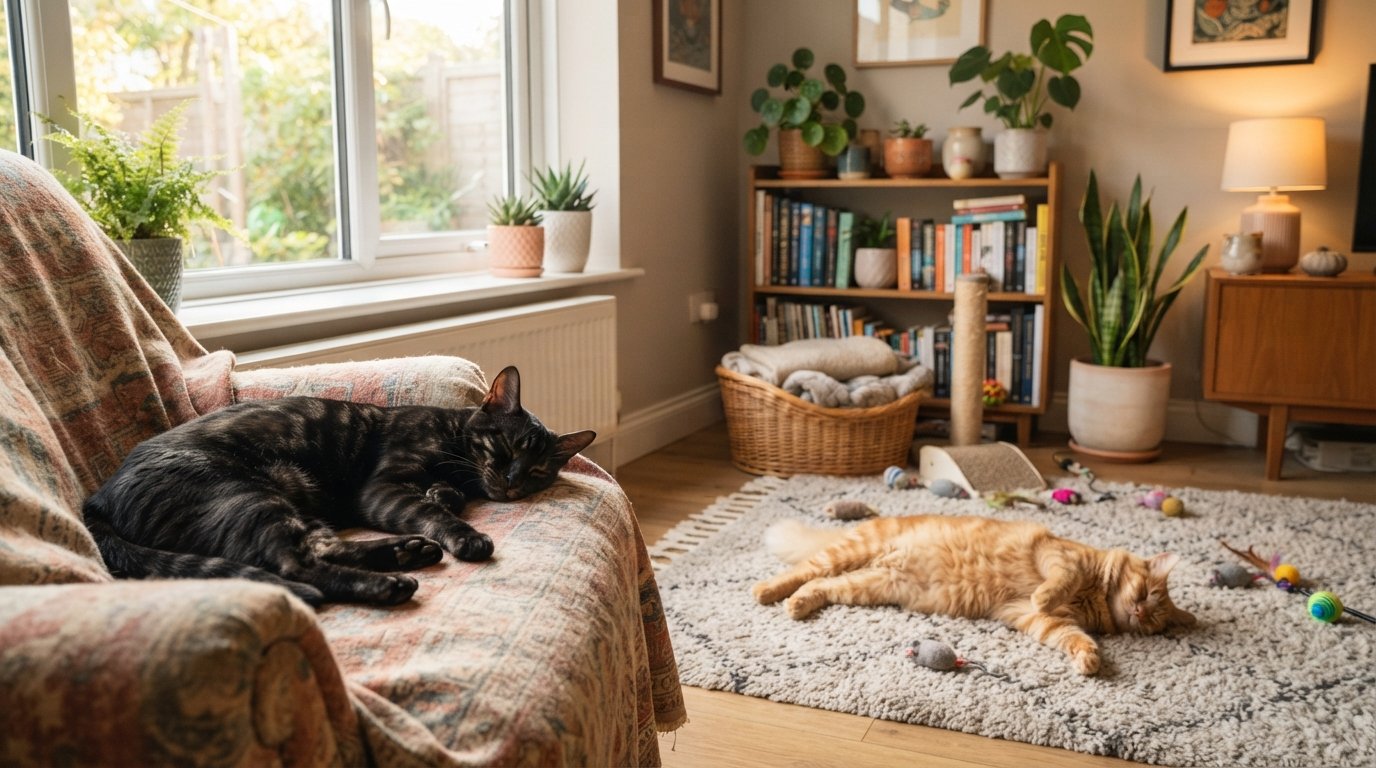
One cat can be the right number for a home, and a second is a good choice only when our space, time, budget, and the cats’ needs allow it. In 2025, cats made up more than half of the pets adopted in the United States. That scale can make adding a cat seem easy, but each animal needs steady care and room to feel safe.
We can make the decision by looking at our daily routine, indoor living space, household pet budget, and the cat already in our home. Animal welfare guidelines center on meeting each animal’s needs, not reaching a certain number. One cat can be a good fit, and another can bring companionship if both cats can live well together.
A staged cat introduction is the process of bringing cats together gradually. Scent exchange means swapping bedding or other familiar items between cats so they can get used to one another’s smell before meeting. These early steps can help, but they cannot promise that two cats will become friends. Treat the cats’ everyday welfare, rather than a target number, as the measure of a successful household.
Is a Single-Cat Household a Good Fit?
A single-cat household can work well when the cat’s care and companionship needs are being met. Cats do not automatically need a feline companion; some enjoy living alone, while others seek more social contact.
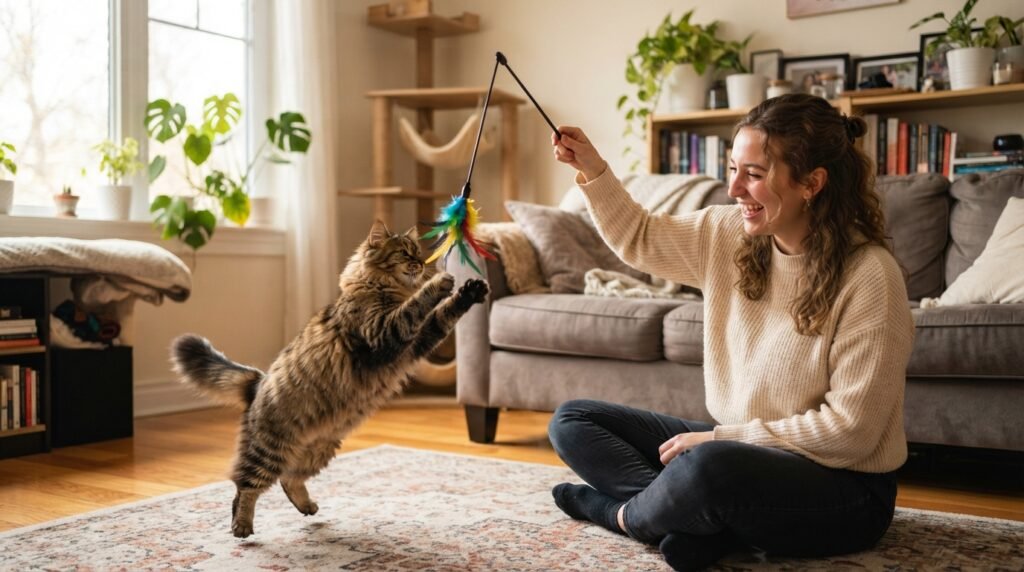
In 2025, cats accounted for 2.2 million of the 4.2 million pet adoptions in the United States. About one-third of U.S. households included at least one cat in 2026. These figures show how common cats are, but they do not mean every home needs more than one.
We can judge our cat’s needs by watching how it behaves during ordinary days. Does the cat seek play, company, or attention, or does it settle comfortably after time with us? A cat that hides, stops playing, or changes its habits may need a health check or a calmer routine, not necessarily another cat.
Our time matters, too. A cat that spends some hours alone may still do well when we offer daily attention and chances to play. A multi-cat household can bring company, but it can also add noise, care tasks, and the need for the cats to share a home.
Cat personality compatibility matters more than the number of cats another family keeps. Some cats enjoy feline company; others prefer people or quiet places. Adding a cat to solve loneliness can backfire if the resident cat finds the newcomer stressful.
We should not assume a cat feels lonely just because it lives alone. Look for patterns in its behavior and consider whether we can meet its need for play and contact. Decide from the individual cat’s behavior and care needs, not from how many cats other households keep.
How Many Cats Should You Have for Your Home?
Use the home’s usable territory and the cats’ access to separate resources to judge whether another cat can fit comfortably. Indoor living space is more than a floor-area number; cats need room to rest, eat, hide, and play without crowding one another.
Estimate usable space and separate resources
As a planning guide, most cats thrive with around 18 to 20 square feet of personal space. Each additional cat may need another 10 to 15 square feet. Treat these estimates as a starting point, not a guarantee that a home can support a certain number.
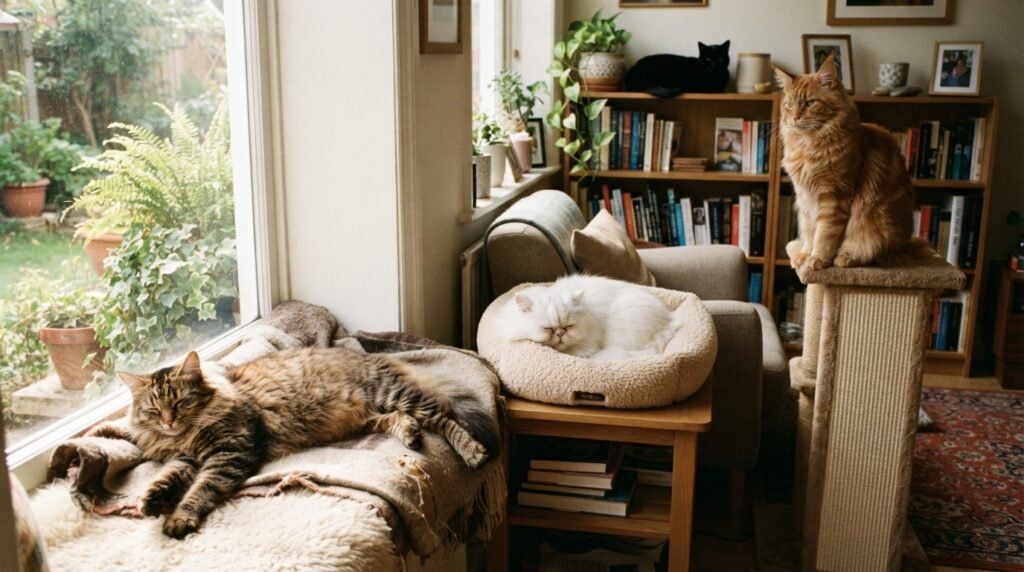
Usable territory includes spots a cat can reach and use without being blocked. A perch, a quiet bed, a hiding place, and a play area can make a small home feel more workable. Separate food and water spots also help each cat get what it needs without competing.
Think about routes as well as resting places. If a cat must pass another cat to reach its food, bed, or hiding place, that resource may not feel safe. More than one path through a room can help cats avoid each other when they want space.
Counting square footage alone can miss the main problem: cats may have nowhere to retreat. A home can have enough floor area on paper and still force cats to share narrow paths or crowded corners. Watch how the cats move through the rooms they use.
Make a one-room home work
A cat can live in one room when it has food, water, a litter box, a place to sleep, and daily enrichment. A room can serve as a cat’s full living area if we keep its needs within reach and offer chances to move, explore, and play.
For a small space, we can use shelves or a sturdy cat tree to add safe places to climb and rest. Rotate toys and offer short play sessions each day. A covered hiding spot can give a cat a break from activity without cutting it off from its supplies.
When more than one cat shares a room, look for a bottleneck at doors, food spots, or favorite resting places. Each cat should be able to leave a shared area without being trapped or forced close to another. Before adding a cat, check that each one can reach everyday resources without passing through a crowded bottleneck.
Can Your Budget Support Another Cat?
Another cat is affordable only if we can cover that cat’s ongoing care as well as unexpected needs. A household pet budget should include regular costs and a reserve, since an adoption fee is only one part of the cost of caring for cats.
Before we commit, we can check four parts of our budget:
- Recurring food and litter: Set one food-and-litter allowance for each cat.
- Routine veterinary care: Include checkups and other care our veterinarian recommends.
- Preventive care or medication: Plan for ongoing needs that protect or support each cat’s health.
- Emergency or boarding reserve: Keep funds available for urgent care or care during travel.
These costs can shift as a cat ages or its health changes. A young cat may need different care from an older cat, and a health issue can bring new costs. We can review our current bills and local care options to see what fits our household.
Per-cat expenses do not always match perfectly. Cats may eat different food or need different medication, so a second cat can add more than another standard food allowance. Use the costs we already pay as a guide, then leave room for needs that change.
The adoption fee does not cover every future need. Food, litter, routine visits, preventive care, and boarding can continue long after the first day at home. We should also be able to handle a surprise bill without setting aside another cat’s basic needs.
When the budget feels tight, we can consider whether a delay would give us more room to plan. A good plan accounts for regular care and unexpected costs, rather than assuming the new cat will need only food. Check the monthly budget against current bills before making an adoption commitment.
How Should You Match Cats and Introduce Them?
A promising match starts with the cats’ individual temperaments, since a gradual introduction cannot guarantee that every pair will get along. Feline socialization works best when we consider each cat’s energy, age, confidence, and tolerance for other cats.
Match energy and temperament
A playful kitten may overwhelm an older cat that prefers quiet. A bold cat may also unsettle a shy one. These pairings can work, but we should not assume age or sex alone predicts cat personality compatibility.
Ask how each cat acts around other cats, new people, and changes in the home. A cat that has lived peacefully with another cat may adjust more easily than one that has always lived alone, though each animal remains an individual. An adoption group may know how the newcomer behaves in its care.
We should think about whether our home can protect each cat’s comfort if they need separate spaces. A well-matched pair still needs time to adjust. Their first meetings should not be the test of whether they can share a room.
Follow a gradual introduction
A staged cat introduction can take several weeks to several months. We begin with separation, then move through scent exchange, visual contact, and supervised interaction. We can slow down or repeat a phase when either cat seems uneasy.
Keep the newcomer in a separate room with its own food and water bowls, litter box, and hiding spots for 1-2 weeks. This gives the new cat time to settle without immediate face-to-face contact. We can check that both cats keep eating and acting normally.
Next, try scent exchange for 1-2 weeks. Swap familiar items such as towels or blankets so each cat can smell the other without meeting. We can also let each cat explore the other’s area at separate times, while keeping them apart.
When both cats seem calm around the other’s scent, allow visual contact for several days to 2 weeks. A secure gate or a partly opened door can let them look at each other while staying apart. If either cat reacts strongly, return to scent exchange and give it more time.
After the cats manage visual contact, try supervised face-to-face sessions. Keep early meetings to 10-15 minutes, and give each cat a clear way to move away. Use treats or play to help the cats stay relaxed, but do not force them close together.
If aggression persists, pause and return to the previous phase before trying again. Hissing or a brief warning does not always mean the match has failed, but repeated attacks or ongoing fear call for a slower plan. End each short meeting while the cats are still calm, rather than waiting for tension to escalate.
What Litter-Box Setup Works for Multiple Cats?
Set out one litter box for every cat and one extra, then make sure the boxes are easy to reach. In a multi-cat household, an extra box gives cats another option when one area feels busy.
Provide enough boxes in accessible locations
With two cats, we should provide three boxes; with three cats, we should provide four. Put boxes in different spots rather than lining them up together, since a group in one place may feel like one shared station.
Choose locations where a cat can approach and leave without being cornered. A box beside a noisy appliance or in a dead-end area may be hard for some cats to use. If a cat guards a doorway, another route to a box can make a difference.
We should also check that a cat can reach a box at night or when a door is closed. A box hidden in a room that a person often shuts may not be available when needed. Easy access matters as much as the number of boxes.
Choose litter and cleaning routines cats will accept
Most cats prefer large boxes that are easy to enter, with litter 1 to 2 inches deep. A large open box gives many cats room to turn and dig. A plastic sweater-storage container can work as a box if it is the right size and easy for the cat to enter.
Most cats prefer clumping, unscented litter. Strong scents may bother cats, even when the smell seems pleasant to us. Cats also generally dislike box liners or lids, so we should not assume a covered box is automatically better.
Useful options include:
- A large open box with room to turn.
- An easy-entry box with a low side.
- Clumping, unscented litter.
- A suitable plastic sweater-storage container.
Scoop and change litter at least once a day. Rinse each box weekly with baking soda or unscented soap, then dry it before adding fresh litter. Skip strong cleaners that may leave a scent cats dislike.
Some cats are fussy about changes in litter type or box shape. If a cat avoids a new setup, we can offer the familiar option while making changes slowly. Keep the cleaning routine consistent, since a clean, accessible box is easier for cats to use.
How Do Allergies Affect the Decision?
Allergies can change the right number of cats for a household, especially when someone living there has significant symptoms. An estimated 15% of U.S. adults and children are sensitized to cats, meaning their immune systems react to cat allergens.
Fel d 1 is a major cat allergen. Sensitization does not tell us how severe someone’s symptoms will be in daily life. One person may have mild symptoms, while another may have a stronger reaction that affects sleep or breathing.
We should consider the health of everyone who shares the home, not just the person hoping to adopt. A known allergy can outweigh an otherwise suitable home setup. Adding another cat may increase exposure, so we should not treat a mild reaction as proof that a second cat will be manageable.
If someone has significant symptoms, we should discuss possible exposure with an allergist before adding a cat. The allergist can help the household understand the person’s symptoms and options. This matters especially when the person has a history of severe reactions or breathing problems.
We can also talk openly as a household about what would happen if symptoms became harder to manage. A cat needs a stable home, and a health concern should not be left for the family to solve after adoption. Include every household member’s health needs in the decision before bringing another cat home.
When Is Your Home Ready to Adopt Another Cat?
We are ready to adopt when we can provide a prepared space, reliable care, and a realistic plan for introducing the new cat. A separate room must be ready before the cat arrives, not arranged in a rush after the adoption.
Prepare the home and care plan
Before setting an adoption date, we can check that the home has:
- A prepared separate space for the new cat.
- Food and water supplies ready to use.
- A litter box and a safe hiding place.
- An agreed care plan for everyone in the household.
The care plan should name who handles daily tasks and who can help if that person is away. We should also agree on which rooms the new cat can use at first. If the separate space is not ready, waiting is kinder than bringing the cat into a busy home without a safe place.
Choose an adoption path that fits the household
We can tell an adoption organization about our experience, home setup, and the cats already living with us. Ask what the cat needs, how it has acted around other cats, and whether the organization can share its known history. Clear answers help us choose a cat whose needs fit our household.
In 2025, 59% of animals entering U.S. shelters came in as strays, while 30% were surrendered by their owners. These figures offer context about animals entering shelters; they do not create a duty to adopt before we are ready.
We can ask whether a trial period or other support is available, then make sure we understand the adoption terms. A cat’s past behavior may not predict every response in a new home, so a patient plan still matters. Confirm that the separate room and daily care plan are ready before setting an adoption date.
What Signs Show That a Multi-Cat Home Is Under Strain?
A household can be under strain even when the cats rarely confront one another face to face. Changes in litter habits, hiding, avoidance, or access to shared resources can show that one cat feels unsafe.
At least 10% of cats develop elimination problems. A cat may stop using its box because of a health issue, conflict, or poor access. We should contact a veterinarian about changes in elimination rather than treating them as misbehavior.
Conflict does not always look like a fight at the box. One cat may control the route to a litter area, or another may avoid a room where it expects to meet a rival. Cats can also have conflict that causes litter-box problems without a direct confrontation there.
We can observe which cat reaches food, water, resting places, and litter areas freely. Notice whether one cat waits, turns back, or hides when another enters. A pattern of avoidance can be easy to miss if we only look for hissing or swatting.
Changes in play, eating, or time spent in shared rooms can also matter. A cat that hides more often or stops using a favorite spot may be responding to stress or illness. Record when the change began and what was happening around the home.
A veterinarian can help check for health causes and guide next steps. We can also adjust access to key resources when one cat blocks another’s route. Treat a change in litter habits as a reason to investigate health and access, not as misbehavior.
Conclusion
The right number of cats is the number whose needs we can meet every day. Responsible cat care means giving each animal reliable attention, health care, and a stable place to live.
Our next step can be simple: write down the time, space, and monthly care budget our household can realistically provide. Then we can decide whether adding a cat fits our life, rather than trying to reach a particular number. Before deciding, write down the care time, space, and budget we can realistically provide.